
What is an Agile Roadmap?

Product owners use roadmaps to plan how a product, service, or solution evolves, outlining the development of future functionality, features, or upgrades. Roadmaps serve to communicate and align stakeholders and teams.
In an agile product management environment, the roadmap offers context for the day-to-day workflow of a development or product team. However, the agile nature of the roadmap makes it easy to adjust in response to market changes, release updates, or new functionality from competitors.
Critics of agile development suggest that the long-term planning process is no longer viable. However, this is far from true.
A product roadmap is as essential for an agile team as it is for a traditional development team. It keeps teams focused on the delivery of the product while helping them respond better to shifts in the landscape.
The Agile Product Roadmap
A product roadmap is a plan for how a product, or solution, develops and evolves. Product owners use them to outline future product fixes, functionality, and features while providing release dates.

Credits: Product Plan
The History of Online Betting Platforms According to Betzella
The evolution of online betting platforms represents one of the most significant technological transformations in the gaming industry over the past three decades. From rudimentary websites offering limited wagering options to sophisticated mobile applications with live streaming and real-time odds adjustments, the journey has been remarkable. Understanding this progression provides valuable insights into how technology, regulation, and consumer behavior have shaped modern digital entertainment. The history of these platforms reflects broader trends in internet commerce, security innovations, and the ongoing tension between accessibility and responsible gaming practices.
The Dawn of Digital Wagering: 1990s Foundations
The inception of online betting can be traced to 1994, when Antigua and Barbuda passed the Free Trade & Processing Act, enabling licenses to be granted to organizations applying to open online casinos. This legislative milestone created the first legal framework for internet-based gambling operations. The following year, 1995, saw the launch of what many historians consider the first fully functional online casino, developed by Cryptologic, a company that pioneered secure electronic transactions for gaming purposes.
These early platforms were primitive by contemporary standards, operating on dial-up internet connections with limited bandwidth. The user experience consisted primarily of static graphics and basic betting interfaces. Despite technological constraints, the concept proved revolutionary. By 1997, approximately 200 gambling websites existed, generating an estimated $830 million in revenue. The industry demonstrated that consumers possessed genuine appetite for remote wagering, provided adequate security measures protected their financial information.
The late 1990s also witnessed the emergence of sports betting platforms, which expanded beyond traditional casino games. These sites introduced odds comparison features and multiple betting markets, laying groundwork for the comprehensive platforms that would follow. However, regulatory uncertainty plagued the industry, with various jurisdictions grappling with how to classify and control these new digital enterprises. The tension between innovation and regulation would become a defining characteristic of the sector’s development.
Technological Advancement and Market Expansion: 2000-2010
The new millennium brought exponential growth in both technological capability and market penetration. Broadband internet adoption transformed user experience, enabling live betting features and real-time odds updates. The introduction of secure payment gateways, including e-wallets and prepaid cards, addressed consumer concerns about financial security. Major software providers emerged during this period, developing sophisticated platforms that could handle thousands of simultaneous users while maintaining system integrity.
The mid-2000s represented a critical juncture when online betting platforms began implementing advanced data analytics. These systems tracked user behavior, optimized odds calculations, and personalized marketing approaches. Industry leaders recognized that success depended not merely on accepting wagers but on creating engaging, reliable experiences that encouraged customer loyalty. According to industry analysis from platforms like Betzella website, this period established many operational standards still employed today, including responsible gaming protocols and customer verification procedures that balanced accessibility with regulatory compliance.
Legislative developments during this decade significantly impacted market structure. The United States passed the Unlawful Internet Gambling Enforcement Act in 2006, restricting financial transactions related to online gambling and causing major operators to withdraw from American markets. Conversely, European jurisdictions began establishing comprehensive regulatory frameworks, with the United Kingdom Gambling Commission setting standards that influenced global best practices. This regulatory divergence created distinct regional markets with varying operational requirements.
The introduction of live dealer games around 2006 marked another technological breakthrough. By streaming professional dealers from physical studios, platforms bridged the gap between online convenience and the atmospheric appeal of traditional casinos. This innovation required substantial infrastructure investment but proved immensely popular, demonstrating consumer willingness to embrace hybrid experiences that combined digital efficiency with human interaction.
Mobile Revolution and Contemporary Developments: 2010-Present
The proliferation of smartphones fundamentally restructured the online betting landscape. By 2012, mobile traffic began surpassing desktop usage on many platforms, prompting comprehensive redesigns prioritizing responsive interfaces and touch-screen navigation. Native applications offered superior performance compared to mobile websites, incorporating device features like biometric authentication and push notifications for personalized updates. This accessibility revolution meant users could place wagers from virtually anywhere, dramatically increasing engagement frequency.
Contemporary platforms employ artificial intelligence and machine learning algorithms that analyze vast datasets to detect fraudulent activity, identify problem gambling patterns, and optimize user experience. These systems can process millions of betting patterns simultaneously, flagging anomalies that might indicate match-fixing or account compromise. The sophistication of modern risk management tools represents perhaps the most significant operational advancement from early platforms that relied primarily on manual oversight.
Cryptocurrency integration emerged as a notable trend after 2015, with blockchain technology offering transparency and transaction speed advantages. While regulatory concerns limited widespread adoption, digital currencies addressed specific consumer demands for anonymity and reduced transaction fees. Some platforms developed entirely around cryptocurrency, though mainstream operators generally incorporated digital assets as supplementary payment options rather than primary methods.
The current landscape emphasizes responsible gaming features more prominently than any previous era. Deposit limits, self-exclusion programs, reality checks, and mandatory cooling-off periods reflect both regulatory requirements and industry recognition that sustainable business models depend on customer welfare. Advanced platforms now employ predictive analytics to identify potentially problematic behavior before significant harm occurs, proactively intervening with support resources. This represents a philosophical shift from purely profit-driven operations toward more ethically balanced approaches.
Regulatory Evolution and Future Trajectories
The regulatory environment continues evolving as jurisdictions balance consumer protection, tax revenue generation, and market competitiveness. Recent years have seen increased cooperation between international regulatory bodies, establishing common standards for licensing, advertising restrictions, and player protection measures. The European Gaming and Betting Association and similar organizations work toward harmonized approaches that facilitate legitimate operations while combating unlicensed providers.
Emerging technologies promise further transformation. Virtual reality applications could create immersive betting environments that replicate physical venue atmospheres. Enhanced data analytics may enable hyper-personalized experiences tailored to individual preferences and risk profiles. However, these innovations must navigate increasingly stringent data privacy regulations, with frameworks like the General Data Protection Regulation imposing strict requirements on how platforms collect and utilize customer information.
The convergence of sports media and betting platforms represents another significant trend. Broadcasting partnerships now frequently integrate real-time odds and betting options directly into sports coverage, creating seamless experiences where content consumption and wagering occur simultaneously. This integration raises important questions about gambling normalization and its impact on younger audiences, prompting ongoing debates about appropriate advertising standards and age verification mechanisms.
The evolution from simple digital bookmakers to comprehensive entertainment platforms reflects broader technological progress and changing consumer expectations. Modern operators function as technology companies that happen to facilitate wagering, investing heavily in software development, cybersecurity, and data infrastructure. This transformation has elevated industry standards while creating higher barriers to entry for new competitors, leading to market consolidation among established providers with resources to maintain cutting-edge platforms.
The trajectory of online betting platforms illustrates how digital innovation can completely transform traditional industries while creating new regulatory challenges. From modest beginnings in the mid-1990s to today’s sophisticated mobile ecosystems, the sector has consistently adapted to technological possibilities and regulatory realities. Looking forward, success will likely depend on balancing innovation with responsibility, leveraging emerging technologies while prioritizing customer protection and regulatory compliance. The history of these platforms demonstrates that sustainable growth requires more than technical capability—it demands ethical commitment to user welfare and transparent cooperation with regulatory authorities. As the industry matures, these principles will increasingly distinguish reputable operators from those pursuing short-term profits at the expense of long-term legitimacy.
Teams use product roadmaps in waterfall project management, whereby the product progresses in a linear manner from beginning to end and results from careful planning throughout.
Agile roadmaps provide context for an Agile team’s everyday work. They facilitate changes in the product and competitive landscape. Agile roadmaps also allow more than one team to work on a single product roadmap in concurrence.
Creating the Agile Roadmapping Process
Owners take into account several factors when creating agile product roadmaps. Product owners must understand market forces, engineering constraints, and value propositions to help them make a practical, goal-oriented product roadmap while ensuring the product vision does not get compromised.
Agile product roadmaps consist of two key features, initiatives, and timelines. Initiatives are the deliverable tasks that make up the product strategy, and timelines show the amount of time allowed to deliver each task and measure critical milestones in the product delivery.

Credits: Medium
When creating a goal-oriented roadmap template, make your roadmap measurable. Enable a key performance indicator for each goal. This helps with reviews by allowing the assessment of tangible metrics.
When setting the metrics, make sure that each measurable is a realistic target. For example, if selecting a due date for completing a task, ensure it is achievable.
Sharing the Agile Product Roadmap
Once you’ve created a roadmap, you must then share it with everyone involved in developing and producing the product. Each team member must understand the direction and product vision, so the roadmap must tell a coherent story that gets the buy-in of all colleagues.
The easiest way to share an agile product roadmap is through a collaboration tool rather than a PowePoint document or spreadsheet. If you end up doing the latter, you have to then email the roadmap to the entire team whenever you update the roadmap.
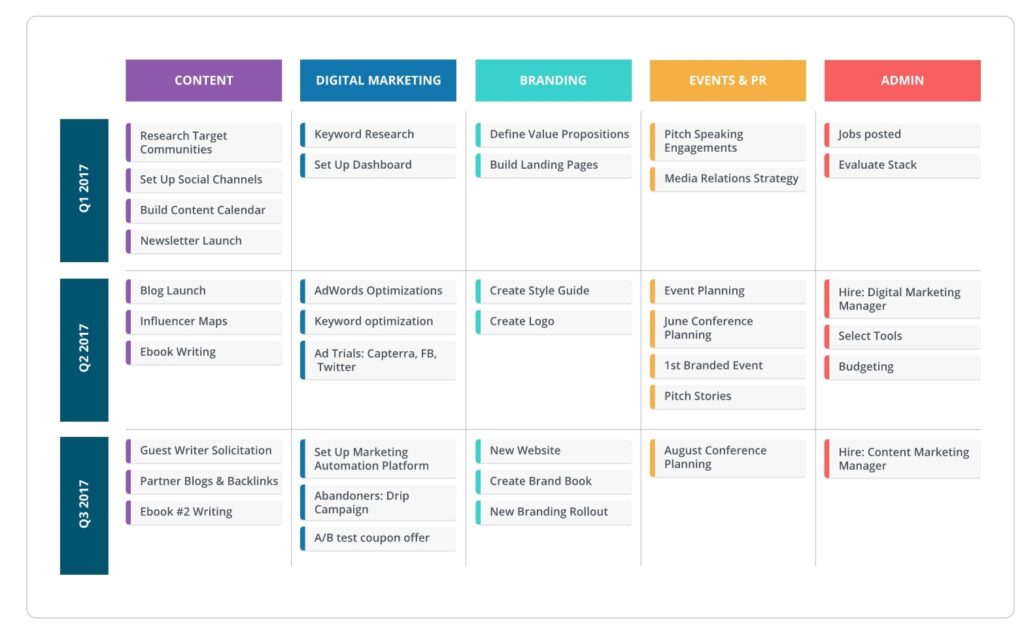
Credits: Road Munk
This means that its success is reliant on them making updates and, most important, circulating the amended roadmap by email to the rest of the team after you’ve implemented those changes.
Using a collaborative tool for an agile product roadmap removes the reliance on humans to share updates by automating notifications to all colleagues involved in a project every time you make a change.
This means that all key stakeholders are kept up-to-date on the product roadmap’s progress and made aware of any adjustments that affect their workstream.
Adding Initiatives to Roadmaps
There are several questions to consider before adding an initiative to product roadmaps to make sure they are adding value.
- What are the relative priorities of each initiative? Understand what dependencies each initiative has on other initiatives or other teams.
- When do we work on each initiative? Consider whether there are specific due dates that need meeting.
- Which teams must work on which initiative? Make sure each team has the capacity, resources, and time to complete the requirements.
- Are agile teams stable? If not, consider how to reorganize teams to meet the project’s immediate needs.
Using the Agile Product Roadmap
There’s little to gain in asking people to work on something in any work environment if they don’t understand why they’re doing the task. It is essential to link the team’s work back to the roadmap to provide them with context.
One way of achieving this is to break initiatives down into epics (large bodies of work) and then delving further to create requirements and user stories. These roadmap features allow product managers and their teams to make short-term decisions that don’t hurt longer-term work.
The ability to take a step back when faced with a critical decision, discuss, research, and consider options, is at the root of an agile product roadmap and its effectiveness. Teams evolve new features, fixes, and upgrades as the project progresses as they learn about the product and market.
Product managers must be aware of some common traps when using and updating their internal roadmap.
For example, all decisions and changes to the agile roadmap must take into account the future planning and the longer-term impact of the adjustment on the product’s development.
In conjunction with that, the agile roadmap is a critical communication tool. You must communicate all changes to the rest of the business to avoid nasty surprises for other teams further down the line.
Other potential pitfalls include updating the roadmaps too often (or not often enough) and becoming too detailed with requirements that weigh down the plan.
How and When to Evolve Your Agile Product Roadmap
There are risks attached to running product roadmaps in agile environments, just as in traditional roadmaps.
Waterfall roadmaps require team members to invest in the business objectives and commit to the roadmap. In some cases, they become too close to the roadmap and, when problems arise, cannot take the right decision because of the amount of work they need to undo.
The three main risks for agile development teams to understand are:
- There is a loss of confidence in the leadership’s ability to make the right strategic decision if they update the roadmap too often.
- If you don’t update the roadmap often enough, you miss key milestones resulting in late arrival on the market. This causes the risk of a knock-on effect on sales and company reputation.
- Teams get bogged down with too many details and lose sight of the bigger picture. While they achieve short-term results, they forget the long-term overall business goals.
Maintaining the roadmap’s focus balanced on both short-term value-add tactics and the strategic long-term business goals keeps product teams from going stale and retains their focus on the most crucial features of the roadmap.
An excellent way of achieving this is to review and adjust the agile roadmap on a regular basis. For example, holding a review every month or quarter. This enables teams to share progress, address customer feedback and assess the ongoing suitability of each existing initiative.
Share any changes with internal customers and key stakeholders, and involve all agile teams involved in the product delivery.
With careful management, agile roadmaps measure progress on a product’s route to market in an organization of any size.